
Helmledgers Insights · Investment Research
The Investment Research Bottleneck: How to Cover More Companies Without Sacrificing Depth
Research capacity is not simply the number of companies on a coverage list. It is the ability to maintain a defensible view of each company as new evidence arrives. Expanding the list without changing the process can create an appearance of breadth while leaving important questions unresolved.
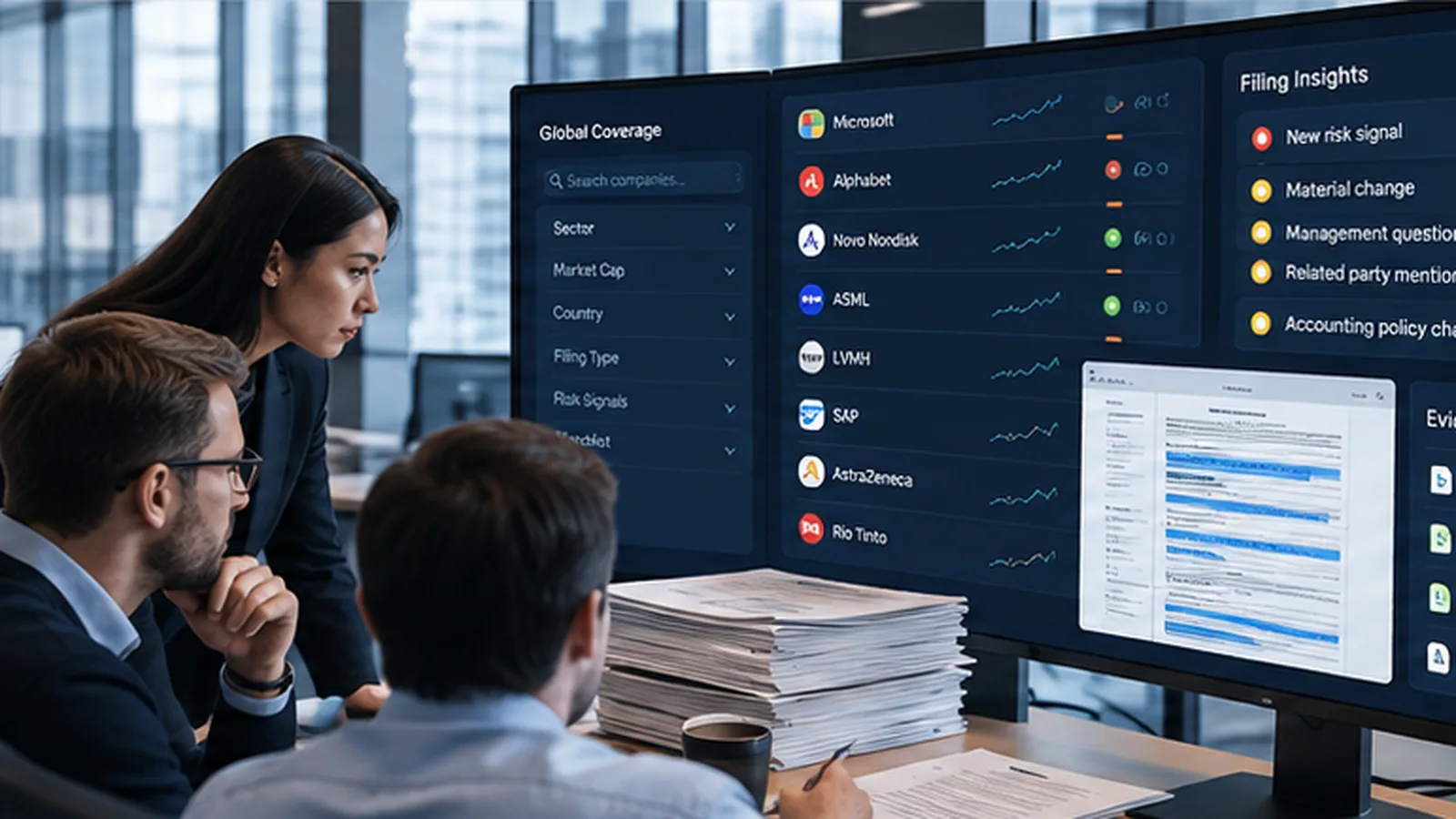
The operational dilemma: coverage versus depth
For a CIO or head of research, the constraint is not only analyst headcount. It is the attention required to maintain models, revisit assumptions, inspect disclosures and challenge an investment thesis. More incoming documents do not automatically produce more informed decisions. They can displace the investigation that gives coverage its value.
Separate breadth from depth explicitly. Breadth means a defined universe receives a documented first pass. Depth means selected issues receive the contextual work necessary to resolve them. Investment research automation is most defensible when it supports that distinction, rather than promising comprehensive judgement across every company.
Find the preparation work before automating the judgement
An equity research workflow includes obtaining the right filing, confirming the issuer and period, locating relevant notes, normalising units and reconciling figures with existing records. Repeated disclosure also needs review: unchanged wording may still sit beside changed amounts or contractual conditions. These are necessary tasks, but they are not all equally judgement-intensive.
The SEC’s How to Read a 10-K maps the annual report’s principal sections, including business, risk factors, MD&A and audited financial statements. A consistent intake checklist can use that structure to organise evidence without implying that a populated checklist constitutes a finished analysis.
Before choosing software, follow a recent filing through your actual process. Where was information gathered twice? Which tables required reconciliation? Which questions waited because nobody owned them? Diagnose the bottleneck from the work itself rather than adopting a generic savings estimate.
Triage is a routing decision; investigation tests the explanation
A first pass should determine what merits attention, by whom and with what urgency. A change in liquidity disclosure, a new covenant discussion or an unexplained divergence between earnings and operating cash flow may justify review. That signal is not yet a conclusion about financial health.
Investigation asks whether the change is material and what explains it. Acquisition effects, seasonal working capital and revised presentation may account for an apparent inconsistency. An analyst should test those explanations against the notes, statements and relevant prior periods before escalating. “Needs review” must remain distinct from “confirmed concern”.
Use explicit review states: awaiting evidence, under investigation, resolved or escalated. An unflagged company should not automatically receive a “clean” designation. A process may have missed a disclosure, encountered an extraction failure or excluded an issue outside its scope.
Standardise the questions, but respect the sector
A common review structure improves handoffs; a universal interpretation of every ratio does not. Start with shared questions about revenue recognition, liquidity, obligations, accounting estimates and changes in presentation. Then adapt the evidence needed to the business model.
For a manufacturer, ask whether inventory growth reflects volumes, mix, acquisition effects or changes in valuation allowances. For a subscription business, examine what contract liabilities say about payment timing and outstanding delivery obligations. For an asset-heavy operator, connect lease or purchase commitments to cash generation and financing flexibility. These are prompts for testing, not mechanical warning rules.
Our discussion of why contract liabilities deserve a second look illustrates how one balance-sheet category can lead to several different questions. The repeatable element is the method of inquiry; the conclusion depends on contractual terms and company-specific evidence.
Build a longitudinal record without rewriting the past
The SEC’s Form 10-Q separates quarterly financial information from other disclosures, including legal proceedings and risk-factor updates. Quarterly review should connect those updates to the annual baseline rather than treat each filing as an isolated document.
Track changes in estimates, segment definitions, liquidity language and contractual terms alongside the numbers. Distinguish discrete-quarter results from year-to-date reporting. If a company recasts a segment history, explain how the comparable series differs from the original reporting. A change log is useful only if the analyst can understand its basis.
Record both the reporting period and the date evidence became available. Later amendments can change what is known now without changing what was knowable at a past decision date. Keep original filings and subsequent corrections distinguishable so retrospective reviews do not mistake hindsight for contemporaneous research.
Evidence provenance makes coverage transferable
A colleague inheriting a company needs more than a summary and a model. They need to see which disclosure supports an observation, what calculation was applied and which questions remain open. Capture the form, accession number, reporting period and an identifiable passage or table with each material finding.
The SEC’s EDGAR data-access guidance provides a route to filing and structured-data records. Design the research record around those identifiable sources, not around an answer that cannot be reconciled to them. A machine-generated interpretation should remain distinguishable from the underlying disclosure.
For team review, assign an owner, preserve dissent and record what would resolve uncertainty. A polished handoff can otherwise create false confidence by stripping away caveats. “Management attributed the change to mix; reconciliation remains incomplete” is more useful than a definitive explanation nobody has verified.
A practical six-stage workflow
- Intake. Confirm issuer identity, form, period and availability date. Establish the prior filing used for comparison and note amendments or missing documents before any analysis starts.
- Monitor. Apply the agreed review scope to new filings. Record changes in financial statements, relevant notes, MD&A and risk disclosures, while retaining unchanged evidence needed to understand the baseline.
- Triage. Route observations according to potential thesis relevance, contractual significance and unresolved uncertainty. Attach the source and a question. Avoid treating textual novelty alone as economic materiality.
- Investigate. Reconcile amounts, read surrounding passages and test alternative explanations. For example, does a liquidity discussion support the assumptions in the debt-maturity analysis, or leave a financing dependency unexplained?
- Escalate. Put material unresolved questions to the relevant analyst or portfolio manager. State what is established, what is inferred and which further evidence or management clarification is needed.
- Record. Preserve the reviewed evidence, decision, owner and follow-up trigger. Close a question with a reason, not just a status change, so the next reviewer can reconstruct the judgement.
Choose automation by controllability, not output volume
Suitable candidates include document routing, locating specified disclosures, extracting reviewable tables and assembling comparisons with explicit period definitions. Selection should depend on whether inputs, transformations and exceptions can be inspected. An ambiguous accounting interpretation should reach a reviewer, not silently become a model assumption.
Evaluate on representative filings, including awkward tables, amendments and changed accounting presentation. Inspect errors as well as apparently successful results. Require visible handling of missing evidence, access controls for confidential research and a review record when configurations change. For tool-level questions, see AI SEC Filing Analysis: What Actually Matters Beyond Summarisation?
The boundary is important: systematic first-pass assistance is not an automated buy/sell decision. Position sizing, valuation, portfolio interaction and investment judgement require a broader evidential and governance framework than filing review alone.
Small teams need a sustainable scope
A small team can begin with one coverage group and a limited set of consequential questions. Name who reviews exceptions and how unresolved work affects claimed coverage. Keep a backlog visible rather than expanding the universe until every company receives only superficial attention.
Helmledgers’ emphasis on filing evidence and accounting questions fits this disciplined approach to scaling investment research; it is not a promise of a particular capacity increase. Get in touch to discuss the review questions your team needs to organise. The goal is broader awareness with a defensible path to depth, not more summaries mistaken for more understanding.
Analytical discussion only. Not investment advice.