
Helmledgers Insights · AI SEC Filing Analysis
AI SEC Filing Analysis: What Actually Matters Beyond Summarisation?
A fluent account of a filing is not the same as an investment-relevant examination of it. For analysts evaluating AI SEC filing analysis, the useful question is not how convincingly a tool describes the document. It is whether the output helps them test an economic proposition against evidence they can inspect.
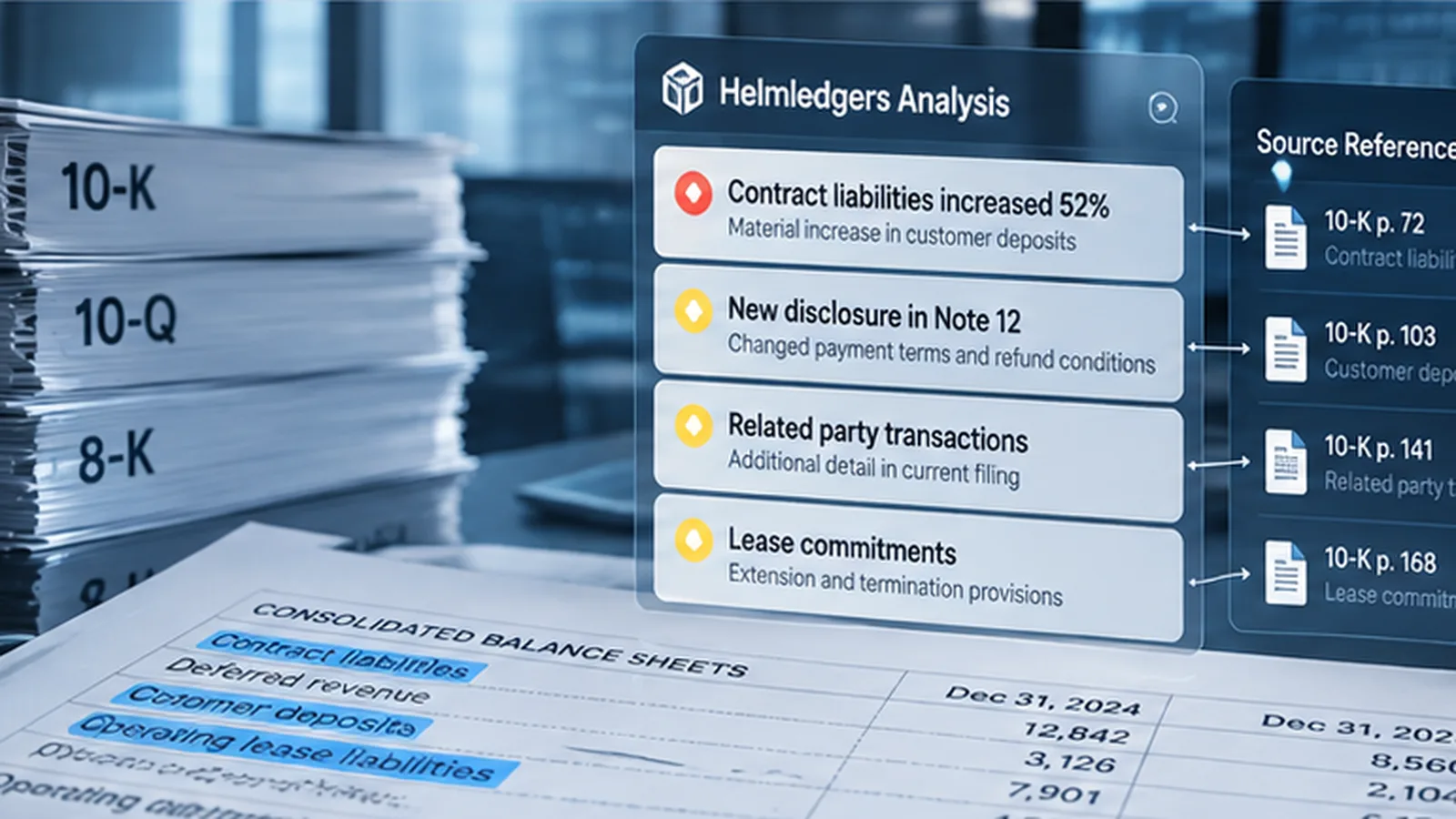
Four different jobs, not one capability
Document search locates a passage: the debt covenant, the revenue policy or the litigation disclosure. Summarisation compresses that passage into a shorter account. Extraction turns information into fields, such as a maturity date or a table of lease payments. Each can be useful without constituting analysis.
Analytical interrogation connects evidence to a question. If receivables rise while sales slow, what explanations does the filing support? Have payment terms, customer mix or acquisition boundaries changed? Does the cash-flow statement reinforce the concern, or complicate it? The task is to evaluate competing explanations, not decorate an extracted ratio with confident language.
Keep these jobs separate when assessing SEC filing analysis tools. A successful search demonstration establishes retrieval, not accounting judgement. A correct extraction establishes a value within a context, not its significance. Ask vendors to show where each capability ends and where the analyst must take over.
Accounting context gives the numbers meaning
The SEC’s How to Read a 10-K explains the roles of financial statements, their notes and management’s discussion and analysis. Read together, they offer different views of the same business: recognised results, accounting assumptions and management’s explanation. No single view should silently substitute for the others.
Consider revenue. A reported increase means something different if it follows an acquisition, includes a change in gross-versus-net presentation, or depends on a different mix of contractual obligations. An automated financial statement analysis should identify the relevant basis of comparison before suggesting that a change represents stronger underlying demand.
Units, reporting periods, consolidation scope and accounting policies belong beside the value, not in an invisible processing step. So do distinctions between a year-to-date cash-flow figure and a discrete quarterly result. A tidy comparison built from incompatible periods can be more misleading than an obvious missing value.
Separate disclosure changes from economic changes
A new paragraph may describe a new exposure, clarify an existing one or reflect a revised presentation. Conversely, unchanged wording does not establish unchanged economics. Reviewers should examine the amount, contractual conditions and business context alongside the textual difference.
A useful comparison asks what changed, what remained comparable and what could explain the difference. Segment reorganisations and reclassifications deserve explicit treatment. If prior figures have been recast, retain both the originally reported evidence and the later comparable presentation rather than overwriting history without explanation.
Company-specific tags add another layer. Our article on custom XBRL tags in SEC filings discusses why familiar-looking financial lines can require closer examination. The practical lesson is to inspect the label and accounting meaning together, rather than assuming a standardised field guarantees a standardised economic concept.
Read beyond the face of the balance sheet
Footnotes can explain commitments, contingencies, guarantees and contractual constraints that headline debt or earnings measures do not capture fully. The SEC guide identifies notes as a source of accounting policies and additional information about financial-statement items. MD&A provides another place to examine liquidity, capital resources and management’s explanation of results.
Do not treat every commitment as unrecognised debt. A purchase obligation, a lease liability and a contingent guarantee can differ in recognition, enforceability and economic effect. Check whether an amount is already reflected elsewhere before aggregating it. Otherwise, a supposedly comprehensive obligation total may simply double-count the same exposure.
Ground the question in the contract: when can cash be required, under what conditions, and how much flexibility remains? A maturity schedule is useful only when connected to available liquidity, operating requirements and relevant restrictions. Missing detail should produce an unresolved question, not an invented estimate.
Source-linked evidence must be reproducible
A link to the filing homepage is a starting point, not a sufficient audit trail. For a material observation, require the company, form, reporting period, filing date and accession number, plus an identifiable note, table or passage. Preserve the cited text and explain any calculation or interpretation applied to it.
The SEC’s EDGAR data-access guidance describes access to submissions and structured financial data. Those records provide source material; they do not certify an analytical conclusion. Reviewers still need to reconcile an extracted fact to its context in the filing.
Reproducibility also means recording the question, documents considered and output reviewed. If a response changes after a model or configuration update, the team should still be able to reconstruct what supported the earlier decision. Distinguish quoted evidence, calculated results and generated interpretation visually and procedurally.
Point-in-time discipline prevents hindsight from becoming evidence
A backdated research question must use information available at that date. The period a filing covers is not the date investors could first read it. Later amendments, restatements and subsequent disclosures may explain an earlier concern, but they cannot establish that the explanation was knowable then.
Define a cutoff, record filing availability and keep subsequent evidence separate. In retrospective evaluations, ask whether the system used later documents or revised data inadvertently. A persuasive explanation assembled after an event is not proof of prospective detection. This distinction matters when evaluating a tool and when reviewing your own research process.
Turn observations into management questions, not accusations
An anomaly is not wrongdoing. It may reflect ordinary business changes, a reporting transition or incomplete information. Human validation should test the source, magnitude, alternative explanations and relevance to the investment thesis before deciding whether escalation is warranted.
“Why did customer payment terms change?” is a more useful next step than “revenue quality deteriorated” when the evidence is incomplete. Record what would confirm or weaken the concern. Accounting review can identify a question worth investigating without establishing motive, forecasting a price move or delivering a buy/sell recommendation.
Seven practical vendor evaluation questions
- Which task is being demonstrated? Ask the vendor to distinguish retrieval, summary, extraction and interpretation using the same filing and question.
- Can every material observation be traced? Open the cited passage and reconcile its units, period and accounting context with the output.
- How are comparisons constructed? Test acquisitions, segment recasts, custom tags and quarter-versus-year-to-date figures rather than only clean examples.
- What happens when evidence is missing or contradictory? Look for explicit uncertainty and competing explanations, not a forced answer to every question.
- Can the information cutoff be enforced? Establish how later amendments and subsequent disclosures are excluded from a point-in-time review.
- What can the team reproduce? Request document identifiers, calculations and a retained review record; ask how updates affect earlier outputs.
- Where does human approval sit? Confirm who validates findings, resolves exceptions and controls sensitive research inputs before wider circulation.
Scale careful research, not confidence
Helmledgers’ editorial approach puts accounting context, filing evidence and questions for investigation ahead of headline compression. That is a research discipline, not a claim that every anomaly can be detected or that judgement can be outsourced. Evaluate any implementation against actual documents and the controls your team needs.
For a concrete starting point, view the existing sample analysis and examine how its evidence supports its questions. For the organisational side, read The Investment Research Bottleneck. The realistic objective is a more disciplined first pass and better-directed investigation, not automated certainty.
Analytical discussion only. Not investment advice.