
Helmledgers Insights · XBRL
Why custom XBRL tags can reveal what standard SEC filing analysis misses
Most investors read the filing. Most AI tools summarise the filing. But SEC filings contain another analytical layer underneath the document: structured XBRL facts, including company-specific extensions that can change how financial information should be interpreted and compared.
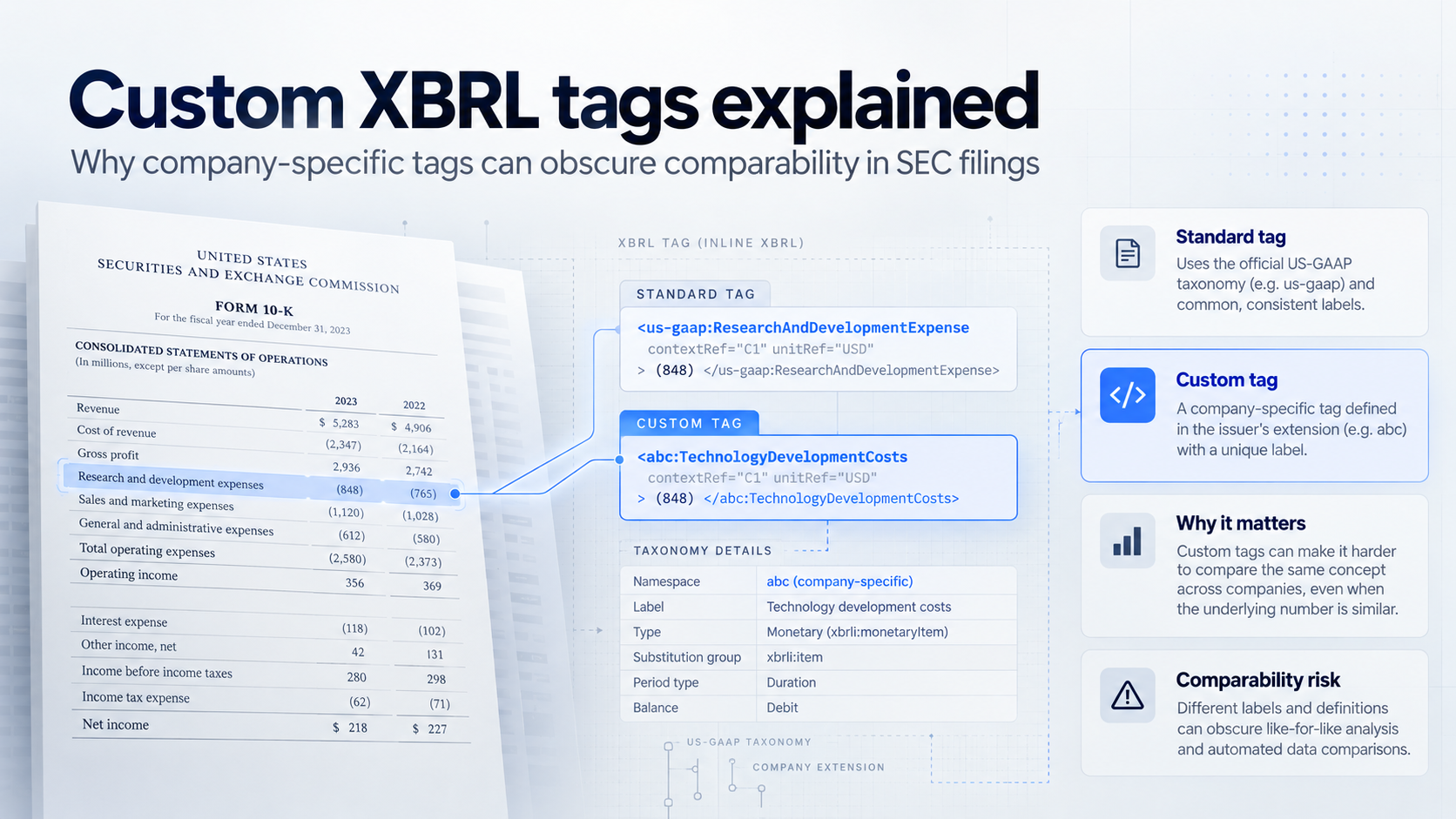
Standard financial statements are only one layer
A 10-K or 10-Q is designed to be read by people.
Underneath that document sits another version of the filing: structured XBRL data that identifies individual financial facts, their accounting concepts, reporting periods, units and dimensional context.
This structured layer allows financial data to be compared and analysed at scale.
But not every company disclosure fits neatly into the standard US-GAAP taxonomy.
When that happens, companies can create custom XBRL tags, also known as company-specific extensions.
These extensions are not inherently problematic. They often exist because a company needs to describe something genuinely specific to its business.
But they can create an important analytical question:
Is this genuinely company-specific information, or has a familiar accounting concept been represented in a way that makes comparison more difficult?
That is where deeper filing analysis begins.
What is a custom XBRL tag?
Standard XBRL tags use established accounting concepts from the US-GAAP taxonomy.
For example, common concepts such as revenue, research and development expense or accounts receivable can typically be represented using standard taxonomy definitions.
A custom tag is created by the filer when it believes an existing taxonomy element does not appropriately represent the disclosure.
This can be entirely legitimate.
The problem for analysts is that different companies can describe economically similar items using different extensions, labels or dimensional structures.
The underlying number may therefore look familiar while the structured accounting representation is not directly comparable.
That matters for:
- peer comparison
- historical analysis
- automated financial screening
- accounting anomaly detection
- AI-based SEC filing analysis
- XBRL-based investment research
Why custom XBRL tags matter to investors
A custom tag should not automatically be treated as a red flag.
It is better thought of as a signal that deserves context.
There are several reasons.
1. Comparability can break
Two companies can report economically similar items while using different XBRL concepts.
A standard data screen may therefore treat them as different metrics even when an analyst would want to compare them.
The reverse can also happen: superficially similar labels may hide different accounting meanings.
2. Important accounting treatments can sit outside standard taxonomy
Company-specific transactions, unusual contractual structures or sector-specific disclosures may require extensions.
These can contain precisely the type of information an analyst should investigate more closely.
3. Automated summarisation can miss the structure
A text-based AI system can read what the filing says.
That does not necessarily mean it understands how the fact was tagged, which dimensional context it belongs to, whether the taxonomy changed, or how the same concept was represented in the prior period.
Forensic filing analysis therefore benefits from interrogating both:
the disclosure text and the structured data beneath it.
The problem is not the custom tag itself
Custom XBRL tags are a normal part of SEC reporting.
The analytical risk comes from interpreting them without context.
Useful questions include:
- Is there an equivalent standard US-GAAP concept?
- Has the company used the same tag consistently across periods?
- Have similar peer companies represented the item differently?
- Does the extension change the apparent comparability of the metric?
- Is the value linked to an unusual accounting treatment?
- Does the surrounding footnote explain why the extension was necessary?
- Has the company's dimensional structure changed?
These questions become particularly important when the value is financially material.
Material balances deserve more scrutiny
A small custom extension may have little analytical significance.
A very large balance may be different.
For example, a material custom-tagged balance involving:
- contract liabilities
- customer advances
- restructuring costs
- acquisition-related items
- guarantees
- asset retirement obligations
- regulatory assets
- impairment charges
can justify a closer review of the underlying disclosure.
The question is not simply:
What is the number?
It is:
What accounting treatment produced the number, how has it been structured in the filing, and how comparable is it to prior periods and peers?
Why this matters for AI-based SEC filing analysis
Many financial AI tools begin with document text.
That is useful for summarisation, search and document navigation.
But accounting analysis often requires another layer.
The analyst may need to understand:
- taxonomy
- dimensions
- units
- company-specific extensions
- period contexts
- restatements
- changed definitions
- filing-to-filing mapping
Without that structured layer, a system can produce a perfectly readable summary while still missing an accounting inconsistency underneath it.
That is one reason source-linked SEC filing analysis matters.
The output should not only tell an analyst what a filing says.
It should also make it possible to understand:
where the fact came from, how it was represented, and what evidence supports the interpretation.
The Helmledgers approach
Helmledgers interrogates both filing disclosures and the structured accounting data underneath them.
The objective is not to flag every custom XBRL tag as suspicious.
Instead, the platform uses accounting-aware analysis to identify where company-specific extensions, material balances, unusual treatments or changes in structured facts deserve closer scrutiny.
Findings can then be linked back to the relevant filing evidence so the analyst can examine the accounting treatment directly.
That enables a workflow closer to:
structured signal → filing evidence → accounting context → question for investigation
rather than:
document → summary
What should analysts do when they encounter a custom XBRL tag?
A practical review should ask:
- What economic concept does the tag represent?
- Why was an extension necessary?
- Is a standard taxonomy concept available?
- Has the tag changed since the previous filing?
- How do peers report the same item?
- Is the balance material?
- What does the underlying footnote say?
- Does the accounting treatment create a management question?
A custom tag is not the conclusion.
It is often the beginning of the investigation.
The broader point
Financial filings contain more structure than appears on the page.
Text explains the disclosure.
XBRL describes the underlying facts.
Accounting analysis becomes stronger when the two are interrogated together.
A filing can look familiar on the page while the structured accounting underneath it tells a more complicated story.