
Helmledgers Insights · Portfolio Risk ·
Portfolio-Wide Accounting Risk Surveillance: How Institutional Investors Detect Emerging Risks Across Holdings
Forensic accounting has traditionally been applied company by company. For institutional investors managing diversified portfolios, the greater challenge is detecting material accounting changes systematically, consistently and early enough to inform investment decisions.
The accounting risk gap in institutional portfolios
Institutional investors have sophisticated systems for monitoring market exposure. Portfolio management platforms can track volatility, liquidity, concentration, sector correlations and factor sensitivities across hundreds or thousands of securities.
Yet an important category of risk often requires a different workflow: the financial reporting assumptions, contractual obligations and accounting judgments underlying individual holdings.
A company may report earnings broadly in line with expectations while its balance sheet, cash flow statement or accompanying disclosures reveal a changing economic picture.
Revenue may be increasingly dependent on management estimates. Receivables may grow faster than sales. Inventory financing arrangements may alter the interpretation of working capital. Customer deposits may provide liquidity while introducing future delivery obligations.
None of these developments automatically implies misstatement or misconduct. Each may have a legitimate commercial explanation.
The investment question is whether the development changes the interpretation of earnings quality, financial flexibility or future cash conversion.
For a portfolio manager holding 100 or more companies, identifying these developments consistently presents a significant research challenge.
The objective of portfolio-wide accounting surveillance is not to replace fundamental analysis. It is to identify where fundamental analysis should be directed next.
Why conventional portfolio risk models can miss accounting anomalies
Traditional portfolio risk systems typically organise exposures around observable market and financial characteristics.
These might include market beta, sector allocation, interest-rate sensitivity, liquidity, leverage, valuation multiples and earnings revisions.
Accounting risk operates at a different level.
Consider two industrial companies with similar leverage, profitability and valuation characteristics. Their conventional financial ratios may suggest comparable risk profiles.
However, one may recognise revenue primarily when products are delivered, while the other relies on significant variable consideration, long-term estimates or customer acceptance provisions.
Alternatively, two businesses may report comparable operating cash flow despite materially different supplier financing arrangements or working-capital practices.
The differences may be disclosed, but not necessarily represented in the quantitative factors used to monitor the portfolio.
This creates a potential surveillance gap.
The issue is not that conventional risk models are ineffective. It is that financial reporting judgment and disclosure-level anomalies are not always captured by the same variables.
Institutional investors therefore benefit from treating accounting intelligence as a complementary analytical layer.
Moving from single-company forensic analysis to portfolio-wide surveillance
Traditional forensic accounting is intensive.
An analyst reviews financial statements, examines footnotes, compares accounting policies, reconstructs transactions and evaluates management disclosures.
The output may be highly valuable, but the approach becomes resource-intensive when replicated across a large investment universe.
Portfolio-wide surveillance requires a different operating model.
Rather than beginning with a comprehensive investigation of every holding, the research team establishes a repeatable process for identifying, classifying and escalating developments that merit attention.
A practical framework has five stages:
1. Establish coverage.
Define the portfolio universe, reporting periods, relevant accounting policies and available primary-source disclosures.
2. Detect changes.
Compare new filings with prior periods, accounting policies and relevant peer disclosures.
3. Classify signals.
Distinguish ordinary accounting developments from unusual movements, emerging uncertainties and potentially material anomalies.
4. Prioritise investigation.
Consider severity, financial materiality, portfolio exposure, evidence quality and the likelihood that further analysis could change an investment decision.
5. Maintain an evidence record.
Preserve the source disclosure, the original observation, subsequent developments and the disposition of each finding.
The aim is to make specialist forensic research more scalable while preserving the judgment and verification required for institutional investment decisions.
What portfolio-level accounting surveillance looks like
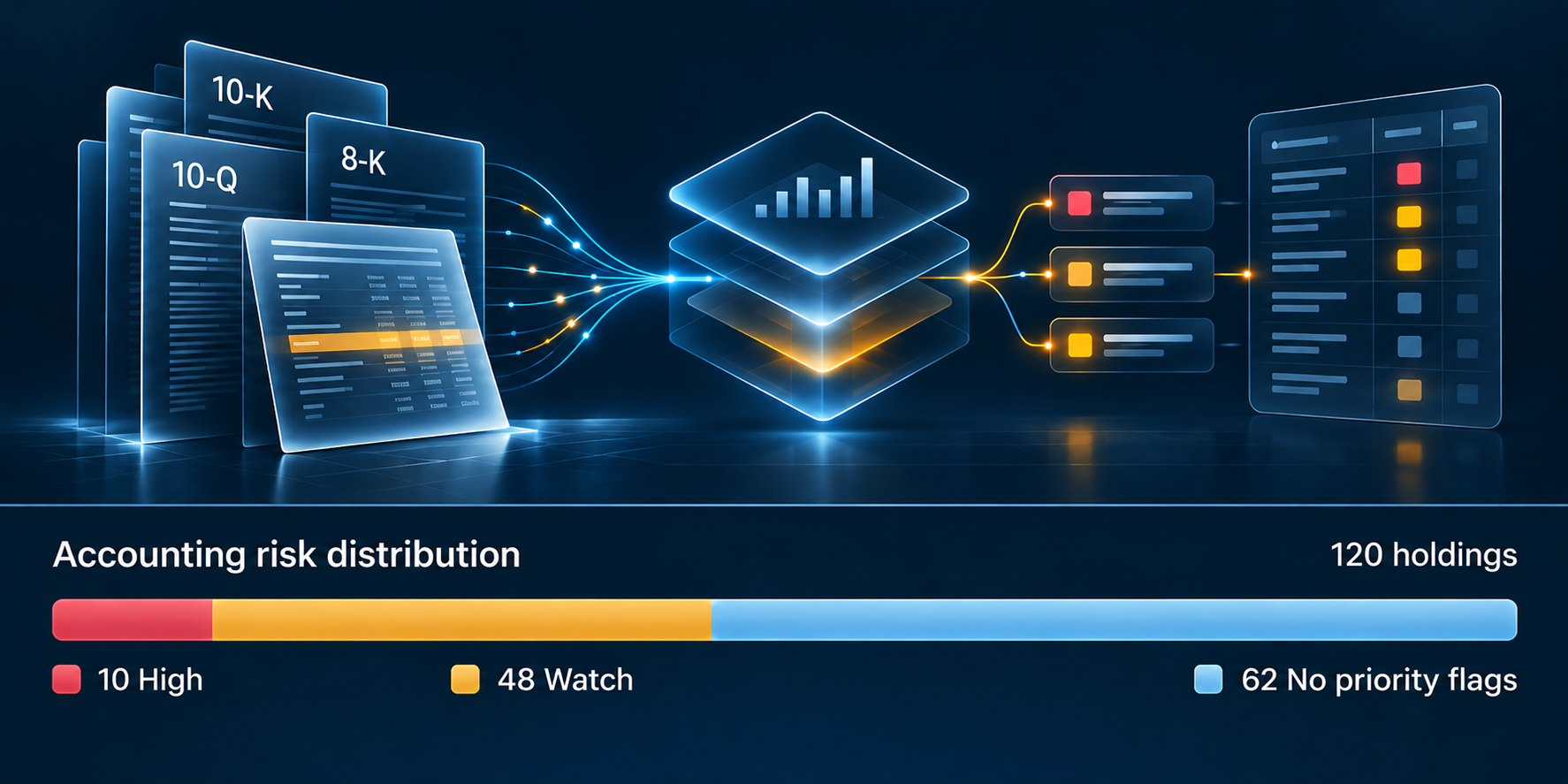
Consider a hypothetical institutional equity portfolio containing 120 companies.
Following a reporting cycle, a structured accounting review identifies 58 holdings warranting some degree of follow-up: 10 requiring high-priority investigation and 48 placed on a watchlist. The remaining 62 have no priority flags under the screening criteria used.
A high-priority finding might warrant immediate review by the covering analyst, while a lower-priority signal could be monitored for confirmation in subsequent filings.
The surveillance framework should also retain the reasoning behind these decisions.
A risk classification without supporting evidence is merely an opinion. A classification linked to specific disclosures, calculations and reporting periods becomes a more useful research input.
Five accounting risk categories worth monitoring across holdings
1. Revenue quality and contract accounting
Revenue recognition is particularly important in businesses with long-term contracts, performance obligations, variable consideration or significant management estimates.
Relevant surveillance questions include:
- Are contract assets increasing faster than recognised revenue?
- Have assumptions about variable consideration changed?
- Are contract liabilities or deferred revenues moving unexpectedly?
- Has management revised estimates of completion, performance or collectability?
The importance of a movement depends on the business model, industry conventions and economic context.
Portfolio-wide analysis should therefore combine common accounting principles with sector-specific interpretation.
2. Cash conversion and working-capital quality
Reported profitability and cash conversion can diverge for legitimate reasons. Persistent or unexplained divergence nevertheless warrants investigation.
An institutional surveillance process might examine receivable growth relative to sales, inventory accumulation, changes in payables, customer advances, noncash revenue and unusual cash flow classifications.
A single quarter of weaker cash conversion may be seasonal. A sustained pattern across multiple reporting periods may suggest a structural change.
The key is identifying patterns that cannot be explained adequately by business growth, operating cycles or disclosed commercial arrangements.
3. Financing arrangements and hidden economic obligations
The economic substance of an obligation may not be obvious from a headline debt figure.
Supplier finance, inventory monetisation, guarantees, purchase commitments, factoring and other arrangements can affect liquidity analysis, financial flexibility or the interpretation of leverage.
Not all such arrangements are problematic. However, changes in their size, structure or disclosure can be important to a portfolio manager assessing downside exposure.
Surveillance should distinguish recorded liabilities from other commitments and contingent exposures, while avoiding the assumption that every contractual obligation is equivalent to debt.
4. Accounting estimates and balance sheet recoverability
Financial statements frequently depend on judgments about future economic outcomes.
Examples include deferred tax asset recoverability, impairment testing, useful lives, warranty provisions, expected credit losses and fair value measurements.
These estimates can change as operating circumstances evolve.
An effective surveillance process asks whether the assumptions remain consistent with the company's disclosed outlook, financial performance and relevant external developments.
The investment significance lies not simply in the existence of estimates but in the sensitivity of reported results to changes in those estimates.
5. Disclosure changes and emerging uncertainty
Some relevant developments are communicated through changes in language rather than movements in headline financial metrics.
Examples include new risk disclosures, revised descriptions of contractual terms, changes in the discussion of liquidity, expanded uncertainty around estimates or modifications to previously disclosed arrangements.
Comparing successive filings can reveal these developments.
A change in wording is not, by itself, evidence of deterioration. But it can provide a starting point for targeted investigation.
For that reason, portfolio surveillance should incorporate both numerical analysis and careful comparison of narrative disclosures.
Cross-company comparison: where portfolio intelligence becomes more valuable
The next level of surveillance involves identifying common accounting mechanisms across otherwise different holdings.
Suppose an asset manager holds several businesses exposed to long-duration contracts, customer prepayments or inventory financing.
Each company may use different terminology, reporting structures and accounting presentations.
A purely company-by-company review risks treating comparable economic exposures as unrelated observations.
A portfolio-level framework can instead classify findings by accounting mechanism, sector, financial statement impact and underlying commercial exposure.
This supports questions that conventional security-level analysis may not answer efficiently.
Are several holdings becoming more dependent on customer advances? Is cash conversion weakening across a particular industry? Are multiple businesses changing their assumptions around the recoverability of assets? Are financing arrangements becoming more prominent across a group of suppliers?
These observations do not establish causation or predictive relationships. They create hypotheses that investment teams can test.
The analytical advantage is a more consistent view of accounting developments across different issuers.
From accounting signals to investment decisions
An accounting anomaly becomes commercially relevant when it can influence a decision.
For a long-only manager, that decision may involve adjusting position size, revising an earnings forecast or requesting additional management disclosure.
For a hedge fund, it might prompt deeper investigation of an existing position, additional downside scenario analysis or reassessment of a short thesis.
For a credit investor, it could alter the evaluation of liquidity, covenant headroom, repayment capacity or structural obligations.
The appropriate response depends on the investment strategy.
Consequently, an effective surveillance process should not rely solely on a generic severity score.
A useful prioritisation framework considers several dimensions:
| Dimension | Investment relevance |
|---|---|
| Financial materiality | Potential significance relative to earnings, cash flow, assets or obligations |
| Change from prior period | Whether the development is new, accelerating or persistent |
| Evidence strength | Whether the assessment is directly supported or depends on additional assumptions |
| Portfolio exposure | Size and importance of the holding within the investment strategy |
| Decision relevance | Whether the finding could change valuation, position sizing or investment conviction |
| Follow-up requirement | What additional information is needed to resolve uncertainty |
A relatively modest accounting development in a concentrated position may deserve more immediate attention than a larger movement in a small, diversified holding.
The objective is not simply to identify unusual disclosures. It is to allocate research resources to the developments with the greatest potential investment significance.
Why timestamped evidence matters
Institutional investment research requires more than a current assessment.
Research teams must be able to reconstruct what information was available at a particular point in time, when an observation was made and how the interpretation subsequently evolved.
This distinction is especially important when evaluating whether an accounting signal could have been identified before a later market event.
A retrospective analysis can inadvertently incorporate information that was unavailable at the original decision date.
A rigorous evidence process should therefore preserve:
- The source filing and reporting period.
- The date the information became publicly available.
- The date the finding was recorded.
- The original analytical interpretation.
- Subsequent disclosures that confirmed, modified or contradicted the assessment.
- The resolution or current status of the finding.
This creates a foundation for evaluating research quality without confusing subsequent outcomes with prior knowledge.
It also supports internal review, analyst collaboration and the continuity of investment research over time.
The role of AI in institutional accounting surveillance
Artificial intelligence can make large-scale document processing and disclosure comparison more practical.
Potential applications include extraction of financial information, identification of changes between filing periods, classification of accounting topics and retrieval of relevant evidence.
However, extracting a figure accurately is not the same as interpreting its economic significance.
A system may correctly identify a substantial increase in contract liabilities without determining whether the movement reflects accelerating customer demand, changing payment terms, business-model differences or increased future obligations.
Similarly, an unusual accounting movement is not necessarily a reporting failure.
Institutional applications therefore require stronger controls than a simple document-summary workflow.
These include source traceability, reliable period comparisons, accounting-specific interpretation, reproducible calculations and clear separation of observed facts from analytical inferences.
Human judgment remains central to deciding whether a finding is material and how it should affect the investment thesis.
The most useful role of AI is to increase the breadth and consistency of the initial review while allowing specialists to concentrate on the findings that warrant deeper investigation.
Building accounting surveillance into the investment research workflow
For research leaders, the implementation challenge is partly technological and partly organisational.
A portfolio surveillance process must define who owns the review, how findings are escalated and what happens when new information becomes available.
It should also establish standards for evidence quality and determine how findings enter the existing research process.
An effective operating model might involve initial screening following each new filing, prioritised analyst review, escalation of material developments, and monitoring of unresolved issues until further disclosures become available.
The output should integrate with the activities institutional teams already perform: financial modelling, investment committee preparation, management engagement, risk review and portfolio construction.
This avoids creating another isolated research repository that analysts must remember to consult.
The objective is a dependable process that turns filing-level information into actionable research priorities.
The emerging opportunity: a forensic intelligence layer for portfolio management
Market risk systems, financial databases and research platforms serve important but different purposes.
A dedicated forensic accounting intelligence layer addresses the information contained within financial reporting disclosures: accounting policies, estimates, contractual arrangements, balance sheet composition and changes over time.
Such a layer need not replace existing portfolio systems.
Instead, it can complement them by identifying evidence-based accounting developments that deserve further investigation.
For institutional managers, the potential benefits are broader research coverage, more consistent analytical standards, improved traceability and better allocation of specialist attention.
None of these outcomes should be assumed automatically. Their value depends on source coverage, analytical accuracy, implementation and the usefulness of the findings to the investment process.
But the underlying research requirement is clear.
As investment universes expand and financial disclosures become more complex, the ability to identify and prioritise accounting developments across holdings becomes increasingly important.
The long-term opportunity is to move beyond isolated forensic reviews towards a structured, repeatable surveillance discipline.
How Helmledgers approaches forensic accounting intelligence
Helmledgers is developing an evidence-driven forensic accounting intelligence platform designed to help investment and risk professionals examine financial reporting disclosures and identify developments warranting closer investigation.
Its approach combines structured accounting analysis, source-linked findings and historical comparison to help researchers move from broad filing coverage to focused investigation.
The aim is not to replace analyst judgment or deliver automatic investment recommendations.
It is to make accounting evidence more accessible, comparable and actionable within the institutional research process.
For portfolio managers and research teams, that means concentrating attention on the underlying questions:
What changed? Why does it matter? What supports the conclusion? And what needs to be investigated next?
Discover how evidence-driven forensic accounting intelligence can support your investment research workflow.
References and further reading
- CFA Institute, Evaluating Quality of Financial Reports, 2026 curriculum.
- CFA Institute, Financial Reporting Quality, 2026 curriculum.
- PCAOB, AS 3101: The Auditor's Report, including the discussion of Critical Audit Matters.
This article discusses research methodology and does not constitute investment advice. Accounting risk indicators are screening and investigative inputs, not proof of misconduct or predictors of future returns.