
Helmledgers Insights · Forensic Accounting
Forensic Accounting for Stock Market Research: Finding Risks Before the Market Reacts
· By Helmledgers
The information is public. The intelligence isn't.
Every quarter, listed companies publish their earnings, balance sheets, cash flows and the notes behind them. All of it is public. Understanding how it fits together takes investigation. Large obligations can build up in the footnotes long before they reach the balance sheet. Cash conversion can weaken while reported profit grows. One changed assumption can alter how a business looks without changing the business at all.
Forensic accounting asks how earnings are produced, what assumptions hold them up, what commitments come with them and what has changed beneath the headline numbers. A large obligation or an unusual accounting choice is not wrongdoing in itself. The aim is to find the questions worth asking, and to tie every one of them to the filing it came from.
A real example: FMC. On 25 September 2026, our read of FMC's Q2 filing flagged $632.4M of rebates owed to customers and a cash position leaning on customer prepayments, documented in a dated email at the time. On 15 October, FMC reset its North American pricing, took a $639M revenue charge and cut guidance; the shares fell 35%. Our scoring of that read is public, including the risk we missed: a non-cash impairment we had not flagged.
That is what a useful finding looks like: an observation linked to its source, a reason it matters, and an honest record of what happened next.
Traditional research can miss the relationships
Professional teams already have financial data, consensus estimates and screening tools. The problem is usually fragmentation, not scarcity. The relevant detail sits across filings, reporting periods, subsidiaries and contracts. A ratio can show that something changed without explaining whether it is operating performance, presentation, or a new dependence on financing.
The questions that matter often sit beneath the headline:
- Cash flow and commitments: are commitments growing faster than operating cash flow?
- Accounting estimates: have critical assumptions changed between periods?
- Revenue quality: is revenue growth matched by outsized growth in receivables or contract assets?
- Leases: are large leases signed but not yet started?
- Company-specific data tags: has the company invented new labels, or changed how it classifies items, in the data it files?
- Disclosure consistency: does management's commentary match the footnotes?
A screen is where an investigation starts. Rising receivables, for example, need context on payment terms, business mix and collection timing before anyone can call them an earnings-quality problem. The work is to test the competing explanations and record the evidence for and against.
The AI infrastructure boom shows why
The AI investment story is told in capital spending, GPUs, cloud demand and capacity. Its financial counterpart is told in leases, purchase commitments and financing. J.P. Morgan Asset Management put the scale at around $4 trillion of off-balance-sheet AI obligations across seven companies (November 2026, based on Bloomberg and company filings). It is a striking number, and a useful prompt. It is also a total of different things.
Leases that have not started, purchase commitments and debt already on the balance sheet differ in timing, conditions and accounting. The total also includes a private company, Anthropic, whose figure cannot be checked against SEC filings in the same way. Adding these together as if they were one kind of debt can hide more than it reveals. The job is to take each figure back to the company's own disclosure.
Microsoft: data-centre leases not yet started
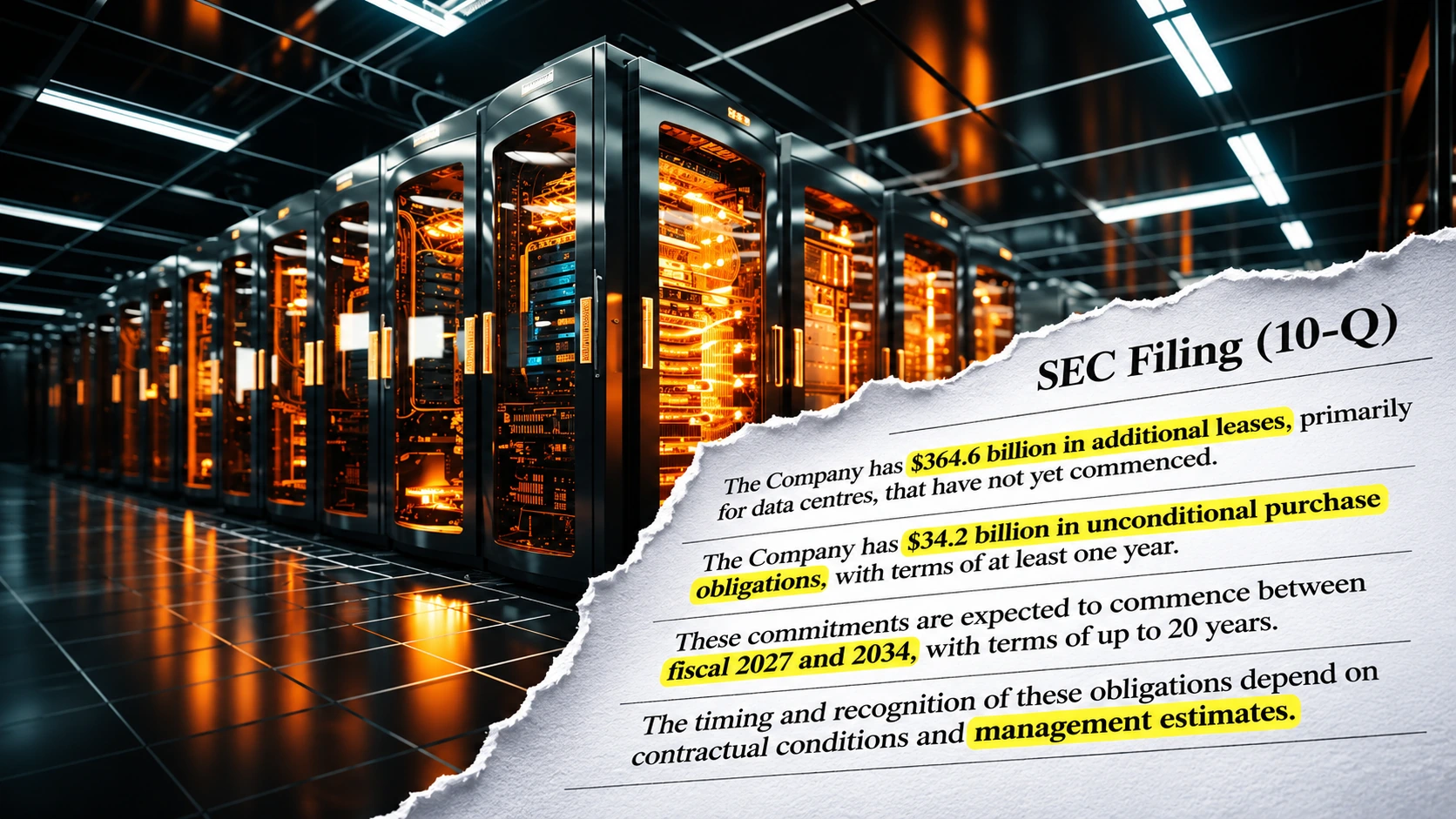
Microsoft's Form 10-Q for the quarter ended 30 September 2026 disclosed $364.6B of additional leases, mainly for data centres, that had not started at the reporting date. They begin between FY2027 and FY2034, run for one to twenty years and carry some conditions. J.P. Morgan's chart shows $575B off balance sheet for Microsoft, so these leases are the largest part of that figure, with the rest in other commitments.
Start dates matter because they set when capacity arrives and when cash goes out. Conditions matter because not every arrangement is the same unconditional promise. The investment question links the commitments to capacity and returns: what utilisation would justify them, and how sensitive is that to slower demand or delayed deployment?
Oracle: two categories that add up
Oracle's Form 10-Q for the quarter ended 31 August 2026 disclosed about $288B of additional lease commitments, largely for data centres, not yet on the balance sheet. They are expected to start from FY2027 Q2 through FY2029, with terms of fifteen to nineteen years. Separately, Oracle disclosed $34.15B of unconditional purchase and other obligations.
Together, those two figures come to $322.15B, which matches the $322B J.P. Morgan shows for Oracle. A headline chart reconciles back to the filings, but only once the two categories are kept apart. The research questions then follow: how will the commitments be funded, what contracted revenue supports them, and what happens if capacity arrives before the cash does?
What credit markets say, and what they don't
Credit default swap spreads are the price of insurance against a company's default. On J.P. Morgan's chart, Oracle's five-year spread had risen to around 300 basis points by late October 2026, against around 60 for Microsoft. Two companies with large, similar-sounding commitments, priced roughly five times apart by the credit market.
That gap is worth asking about, but it is not a verdict. Spreads also move with hedging demand, liquidity and positioning, and they say nothing directly about accounting. The spread tells you what protection costs today. The filings tell you what the obligations are and how they line up with cash generation. Good research uses both, without reading wrongdoing into a price.
Not every commitment is hidden debt
A lease that has not started, a purchase commitment, a guarantee and a loan are not the same thing. Six questions keep a big total from turning into a lazy conclusion:
- Nature: what exactly is the obligation, and what does the company get in return?
- Conditions: what terms govern enforceability, cancellation or contingent performance?
- Timing: when does it start, and when is cash actually due?
- Accounting basis: why is it on the balance sheet, disclosed separately or left out of a table?
- Capacity: what cash generation and financing support it?
- Movement: how has the exposure changed, and does the disclosure explain the change?
Where the reconciliation is incomplete, a good finding says so. Uncertainty is a reason to keep digging, not permission to call every commitment concealed borrowing.
Compare filings over time
One filing is a snapshot; research needs the sequence. Comparing quarters shows changes in the mix of commitments, maturity schedules, estimates and cash generation. Restatements and presentation changes need careful handling, so a different reported number is not mistaken for a different underlying exposure.
Say a company's future commitments grow across three quarters while operating cash flow stays flat. The questions follow naturally: what was added, did anything replace earlier arrangements, and is there revenue behind the new capacity? The direction alone doesn't settle the investment case.
Why honest timing matters
A disclosure can look obvious after the event that it wasn't before it. Explaining something in hindsight is not the same as predicting it, and research that blurs the two loses trust fast.
So we record what was known and when. Every Helmledgers read is timestamped when it is published, its watch points are set before the next results, and each one is scored afterwards, including the misses. This article discusses public filings as of 8 November 2026 and claims no earlier identification of the Microsoft or Oracle examples.
The same questions, every sector
In manufacturing, inventory, financing arrangements and purchase obligations interact with production plans and working capital. In pharmaceuticals, milestone payments and contingent consideration depend on triggering events. In retail, leases, supplier finance and working-capital swings change how cash generation looks. In aviation, loyalty-programme deferred revenue raises questions about redemption and recognition.
The discipline is shared, but the rules and the economics are sector-specific. A generic summary can find a paragraph; it cannot judge whether it matters. That is why we build sector-specific checks, and why findings stay tied to their source.
An evidence layer, not a prediction engine
Forensic signals are prompts for investigation, not accusations. A commitment may be commercially sound; an accounting treatment may be entirely appropriate. What forensic work offers is a more defensible process: public information connected to accounting logic and explicit questions, with an honest record of how those questions played out.
See it in action, free: every Helmledgers read, its watch points and how each one scored are at app.helmledgers.com/my-portfolio. Or get in touch to discuss what your research team needs.
Public filings. Proprietary intelligence.
Sources and research note
- Microsoft Form 10-Q, quarter ended 30 September 2026
- Oracle Form 10-Q, quarter ended 31 August 2026
- J.P. Morgan Asset Management, AI off-balance-sheet obligations and five-year CDS spreads (Bloomberg and company filings), October and November 2026
Educational research, not investment advice or a recommendation to buy or sell securities. No allegation of wrongdoing is made against any company discussed. The approved editorial image is a visual composite of different issuers; its highlighted figures must not be read as one company's accounts.